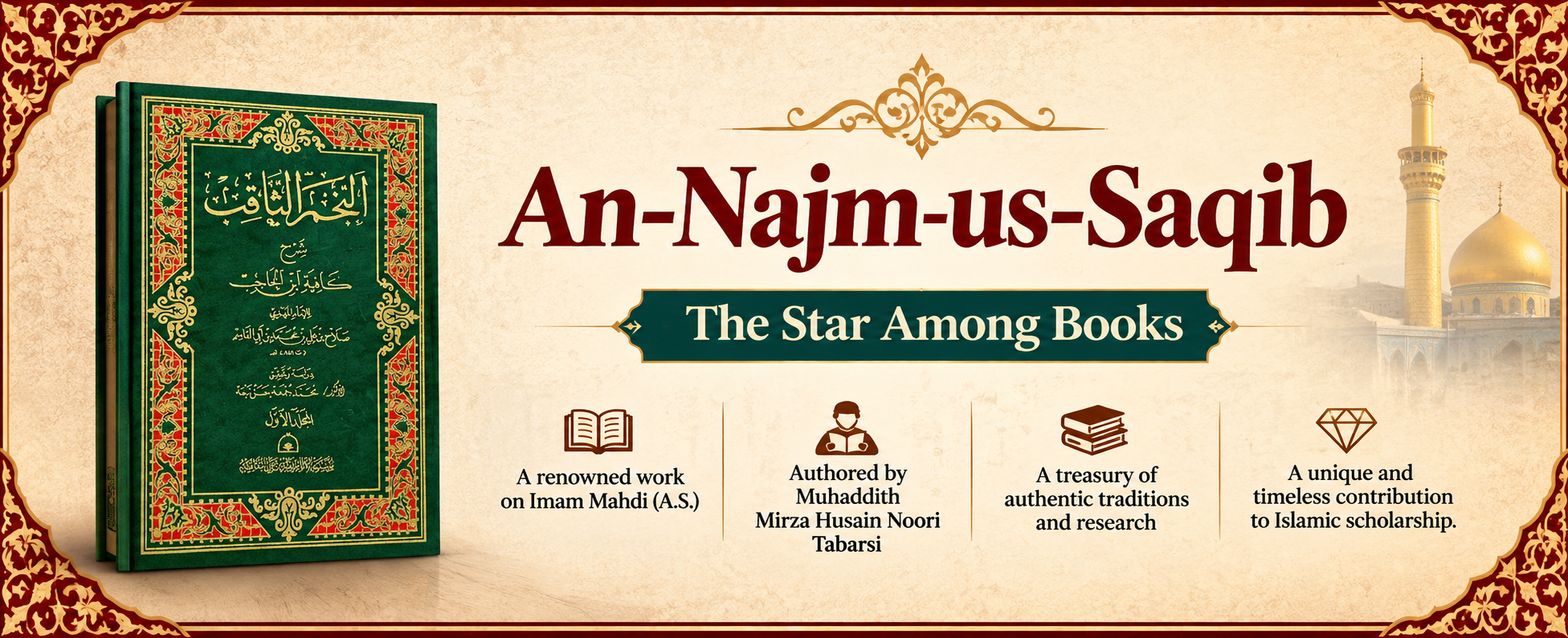
Janabe Zahra (a.s.) informed the mother of Muhaddith Mirza Husain Noori:”O Ummal Husain ! Your son Husain has started writing a book on my son Mahdi. He has titled it ‘An-Najm-us-Saqib’.” While uttering these woods, the luminous face of Janabe Zahra (S.A.) lit with delight.
The belief regarding Hazrat Imam Mahdi (A.S.). holds such importance in Islam that in every period, numerous scholars have either written books on or devoted special chapters for it. These actions have ensured them everlasting rewards in the hereafter.
Among this treasure of books, the one by great Muhaddith Al Haj Aqa Mirza Husain Noori Tabarsi, “AnNajmus Saaqib Dar Ahwaal Imam e Ghaib”, stands apart.
ABOUT THE AUTHOR Birth
Muhaddith-e-Noori was born in 1254 A.H. at a village called “Noor”. His father was Mirza Mohammed Taqi Noori (R.A.). While still a young boy, death deprived him of his father. He obtained his elementary education at his native village of Noor. Later, he travelled to Tehran, Samarrah, Kazmain, Karbala and Najaf for higher studies and studied under the leading scholars of that time. By his continuous efforts, extra-ordinary talents and memory, he attained mastery over the science of traditions i.e. Ilmul Hadith. Muhaddith-e-Noori expired at the age of sixty six in 1320 A.H. in Najaf-e-Ashraf. He was buried in the eastern yard of the holy shrine of Ameerul Momineen, Ali (A.S.).
Allama Aqa Buzurg Tehrani (the author of Az-Zareeah) narrates from Sayed Mohammed Kashani, “Seven years after the death of Muhaddith-e-Noori, his wife also died. She was to be buried next to Muhaddith e Noori. When his grave was dug, it was found that his body had not decayed. Even the colour of the shroud cloth (Kafan) was untouched, neither torn nor eaten by worms. Thus, we can say that the servants of the Ahlul Bayt (a.s.) and those who lay down their lives for them, live forever.
Teachers
Muhaddith-e-Noori was trained under great teachers of his time. He acquired elementary knowledge from Maula Mohammed Ali Mahallati. At Tehran, his teacher was Shaykh Abdur Raheem Burujardi. His other teachers were Ayatullah Shaykh Abdul Husain Tehrani and the highly celebrated teacher of the jurists Ayatulla Shaykh Murtuza Ansari at Iraq. Lastly, he studied under the famous Marja of that time Hazrat Ayatulla Al Uzma Mirza Muhammad Hasan Shirazi (who is wellknown for his edict (fatwa) against tobacco which succeeded in defeating the aims of the enemies of Islam). The impeccable training of his teachers made Muhaddith-e-Noori a luminous personality.
Intellectual achievements
Allama Shaykh Buzurg Tehrani writes, “Muhaddith-e-Noori is the best example of the past scholars. In his time, none was his equal. He alone scaled the heights of intellectual achievements and was a unique example of the divine signs. He possessed unlimited capabilites and qualities and was thus able to command respect as a scholar even at a young age. He passed his entire life in the service of religion. He shall live forever in his writings. His influence upon other scholars will be everlasting. He pledged his life in the way of knowledge. All his efforts were aimed in collecting, compiling, classifying and elaborating the traditional reports (ahaadith). He collected some very valuable treasures in the field of traditions. It seems as if he was created only to compile the traditions of the holy Ahlul-Bayt (A.S.).” (Mustadrak al Wasael, Vol. 1, New edition)
The great traditionalist Shaykh Abbas Qummi writes about his teacher thus:. He possessed the gist of every type of knowledge. He had expertise in the science of traditions and Ilme Rejaal (the science of the narrators of traditions). He had profound insight into the meaning and applicability of the traditions. His command upon these sciences was astonishing.”
(Fawaidur Razawiyyah, p.152)
Allama Murtuza Mutahhari (r.a.) says: “If Muhaddith Noori quotes a tradition from non-Shia channels, it means that it has not been quoted by any one of the Shia traditionalists. For, it is impossible for a tradition recorded by a Shia traditionalist to go unnoticed by Muhaddith-e-Noori.” (Guftaar-e-Man, Vol. 1, p. 98)
His Students
Although, every scholar who was his junior benefitted from his guidance, his outstanding pupils include the great Aqa Buzurg Tehrani, the author of Az-Zareeah and Tabaqaatul Islam wa al-Shia. Another student who earned fame was Allama Shaykh Abbas Qummi, who penned Safeenatul Behaar and the widely read Mafaateehul Jenaan.
His Writings
Despite his numerous responsibilities and duties, Muhaddith Noori compiled nearly thirty books. Each of his books remains unsurpassed in merit. Aga Mulla Mohammed Kazim Khorasani (the author of Kifayatul Iddith Usool) said in a gathering of five hundred Mujtahids regarding the masterpiece of Muhaddith-e-Noori, “Mustadrakul Wasael”: “Alongwith other books, it is necessary to study Mustadrakul Wasael. Without it, attaining Ijtehad is not possible.” (Mustadrakul Wasael, Vol. 1, New edition)
Some of his works
(1) Mustadrakul Wasaael – First this book was printed in three large volumes. Now it is published in 18 volumes.
(2) Darus Salaam Feema yatallaqo birroya wal manaan – Consisiting of four volumes, this book deals with the interpretation of dreams and other related topics.
(3) Masalimul Bahr fi istibrakul bihar as-saabe ashar
(4) Jannatul mawa fi mun faazaa be leqaa e Hujjat alaihis salam fil ghaibatil kubra – This book contains anecdotes of those people who had the honour of meeting the Imam-e-Zamana(A.S.) during the major occultation. Now, it is published as a part of Allama Majlisi’s Behaarul Anwaar (53rd volume).
(5) Faizul Qudsi fi Abwaal Allama Majlisi – It is a biography of Allama Majlisi. It is also published with Behaarul Anwaar.
(6) As Sahifatus-saaniyatul alawiyya
(7) As sahifatur Rabe al Behaariya
(8) Najmus saqib dar ahwal Imam Ghaib (A.S.)
(9) Lo Lo wa Marjaan – This book contains advices and exhortations for the orators and speakers.
(10) Kashful astaar fi abwaal al Imam al ghaib anil abasar.
Worship and Piety
Muhaddith-e-Noori was a manifest exemplar of worship and piety. In the words of Shaykh Abbas Qummi, “Muhaddith-e-Noori paid special attention to worship. He was very pious. He never missed the recommended Salat-eShab and invocation to Allah in the serenity of the night. He possessed every type of merit.” (Fawaaidur Razaviyyah, p. 153)
Muhaddith-e-Noori had allotted time for everything. From Asr prayers upto sunset, was for writing. He studied from Maghrib till the time of going to bed. He always slept with ablution (wuzu) and purification. He used to go to the shrine of Ali (A.S.) for an hour. Since at that time the door of the shrine was kept closed, he used to perform the Namaz-e-Shab outside. When the door of the shrine opened, he entered the shrine as it’s very first visitor. He assisted the care-taker in opening the other doors & windows. Thereafter, he lit the candles of the holy shrine. After which, he used to recite the invocations and salutations till the time of the morning prayers. After performing the morning prayers, he used to continue the recitation of Duas after the prayers till sunrise. On Fridays, when he returned from the shrine, he studied the books of tragedies that afflicted the Ahlu Bayt (a.s.). When he narrated the afflictions of Ahlul Bayt (a.s.), his beard became wet with tears. He did not sit to write after Asr on Fridays, but used to go to the shrine and recited invocation till the time of Maghrib.”
(Tabaqaat-eAlaamush Shia)
Muhaddith-e-Noori and Imam-e-Qaem (A.S.)
Imamat and mastership are the strong principles of the religion of Islam. The recognition and love of Imam (A.S.) is obligatory upon everyone. The first and foremost duty of every Shia is to obtain knowledge regarding his Imam (A.S.). He must know as to what pleases and displeases our Imam (A.S.). In the time of the major occultation, the best action is to wait for his reappearance. It is the duty of the scholars and the learned to make the people aware of their responsibilities and thus bring them nearer to Imam-e-Asr (A.S.). If it is not so, then under whose patronage have they raised the standards of religion?
Muhaddith-e-Noori was among those exalted scholars who achieved merits in this field. A poet, in a single couplet, objected against the belief of Mahdaviyat. To reply him, Mohaddes Noori wrote a full length book titled, “Kashful Astaar Fi Ahwal Al Imam An Naib Anil Absar.” This book explained as to how despite his occultation, Imam-e-Asr (a.s) helps his Shias and takes care of their affairs. He wrote another book “Jannatul Mawa Feeman Faazaa Beleqaae Al Hujjat (A.S.) fil ghaibatil Kubra.” This book records the incidents of those fortunate people who had the honour of meeting the Imam (A.S.) in occultation.
The first book consisted of three parts. The first part dealt with those Sunni scholars who have confessed to the belief of Hazrat Mahdi (A.S.)’s existence. The second part replies to the objections against occultation. The third is in reply to various other objections like “The fiction of the cellar.”
Najmus Saqib dar Ahwaal-e-Imam-e-Ghaib (A.S.).
This is a comprehensive book about Imam Mahdi (A.S.). Before presenting the summary of this book, let us read the following incident:
One day a reliable and respected scholar saw Muhaddith-e-Noori strolling in the scorching heat of Samarrah. He asked the reason for being outside on such a terribly hot day. Mohaddis replied, “I was sleeping in the cellar, had a pleasant dream and hence came out in delight. I saw my mother telling me, May you achieve honour in this world as well as in the hereafter. You have earned for me a place of honour among women. Everyday I am present in the service of Hazrat Zahra (a.s.). She (S.A.) makes me sit besides her and addresses me as ‘Ummul Husain’. Whenever you begin writing a book, she (s.a.) informs me of it. Today when I went in her presence, she (s.a.) accorded more than usual respect to me saying, “Ummul Husain! Your son has begun writing a book concerning my son Mahdi. He has · titled it ‘Najmus Saqib’. While saying this, the signs of delight became apparent upon the luminous face of Hazrat Zahra (a.s.).” (Najmus Saqib)
The twelve chapters of Najmus Saqib: Each chapter deals with the following aspects of Imam Mahdi (a.s.)’s life .
CHAPTER ONE: Birth
CHAPTER TWO: Names, Titles and Agnomens
CHAPTER THREE: Characteristics and Merits
CHAPTER FOUR: Authenticity of the belief in him [a.s.)
CHAPTER FIVE: His being the son of Imam Hasan Al Askari (A.S.) , 1.
CHAPTER SIX: Forty miracles.
CHAPTER SEVEN: Hundred incidents of those who had the honour of his meeting
CHAPTER EIGHT: Possibilities of his visitation in major occultation
CHAPTER NINE: Helping the people and answering their invocations during occultation
CHAPTER TEN: Ten duties of the Shias in the major occultation
CHAPTER ELEVEN: An account of the special timings and days and the prayers specially devoted to him (A.S.)
CHAPTER TWELVE: Those actions and deeds which are a cause of proximity to him (a.s.)
The titles of the different chapters are enough to show the comprehensiveness of this book. It would enable the people to be more knowledgeable of their Imam (A.S.). If someone could summarise and translate it in other languages, it would help the readers to be nearer to the Imam of their time.”