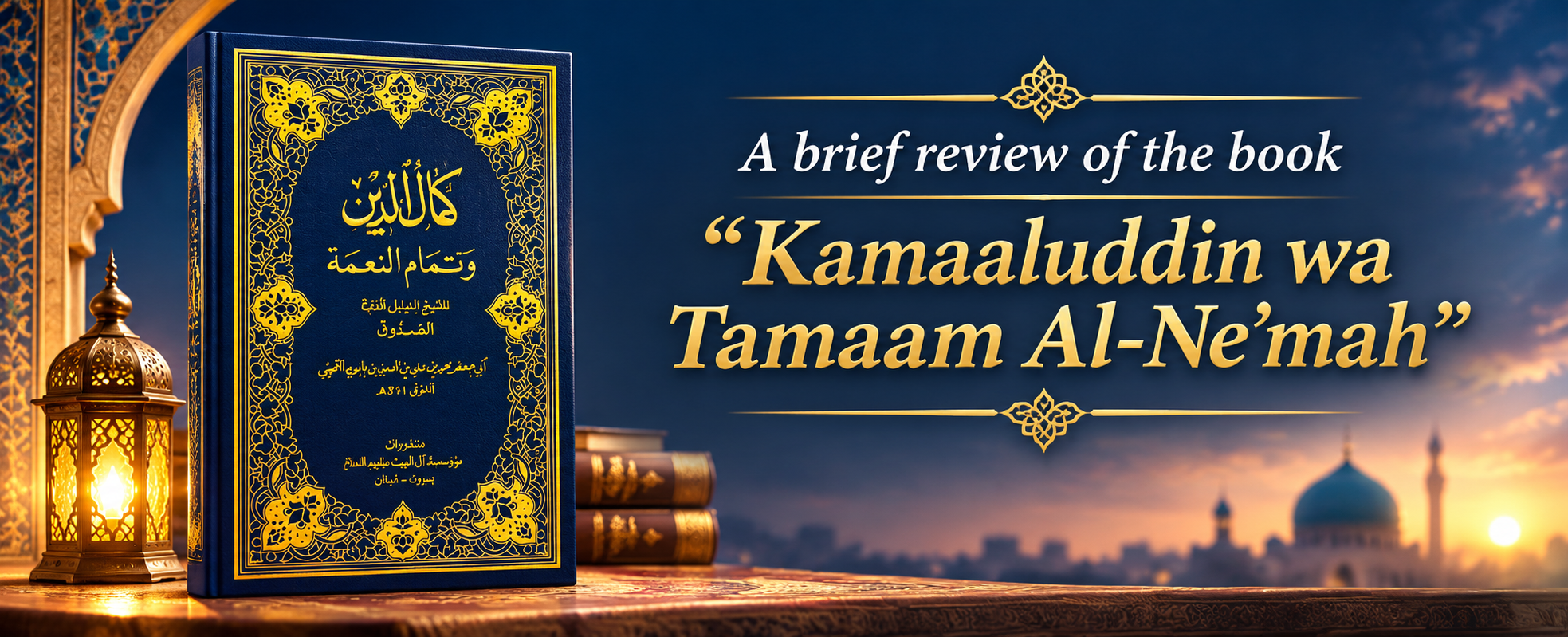
After the martyrdom of Holy Prophet (s.a.w.a.), at the hands of those vying for power, the religion that was sent to the earth, gradually began to change, and with the passage of time, the traditions and their erroneous comprehension began to emerge, the principles of religion were distorted and also the elements of the tendency to alter religion as per one’s convenience, the historian’s too fell prey to corruption. Those who pretended to oppose forged traditions, were appointed as courtiers. From Abu Hurairah till Yahya ibn Aksam, and many such agents of government came to fore wearing the religious garb. But the religion that Allah is pleased with, and which was revealed as an unexpected blessing for the mankind on this earth, He provided all means to protect it. If, on one hand, the self-imposed rules of the opponents came to fore thereby putting the religion in the mould of kingdom, then, on the other hand, Allah, the Almighty send such holy personalities who preserved the sanctity and sublimity of religion. With this preface, in this issue of “Al-Muntazar”, we will mention about the services of those important personalities who left such precious gems in the service of religion that exposed the evil faces of the hypocrites and brought to fore the immaculate form of religion. Earlier, we had the opportunity to write an article about the introduction of Martyr Allamah Noorullah Shustari (a.r.) and now we will mention about the book “Kamaaluddin wa Tamam al-Ne’mah”.
It is enough to say about the importance and greatness of this precious book that the author of this book is Abu Jafar Mohammad bin Ali bin Husain Baabwayh Qummi, commonly known as Shaikh Saduq (a.r.), who hailed from a scholarly family from the city of Qum in Iran. He was born by the prayers of Hazrat Imam Mahdi (a.s.) in 306 A.H. and expired at the age of 75 years in the year 381 A.H.
He was a great Shia leader, the pillar of religion, a genius of high calibre, and even before his birth, Hazrat Imam Mahdi (a.s.) mentioned him in one of his Tauqeeaat as truthful, virtuous, and authentic.[1]
He enlightened the world with his writings. He possessed wide authority in religious verdicts. Questions related to various topics were sent to him from all corners of the Islamic and academic circles, that were answered by him. In this regard, Najjaashi has mentioned a book named “Al-Masaael” containing the answers to these questions. He says that there is also another book on the answers to the questions that came from Qazvin, Egypt, Madaaen, Basra and Nishapur. Apart from this, Shaikh Saduq (a.r.) also replied to various letters. In the context of his books, Najjaashi has mentioned the debates held in the court of Rukn-ud-Daula that comprises of the first debate, the second debate, the third debate, the fourth debate and the fifth debate. Affirming the veracity of the Imamia beliefs in all these debates, especially the topic of occultation, is an excellent example of his relentless efforts, and his proximity and love towards Imam Mahdi (a.s.).[2]
On the other hand, the sects of Zaidiyah, Kaysaniyah, Ismailiyah, and the Waaqifiyah, who did not believe in the Imamat of Hazrat Imam Ali Reza (a.s.), joined hands to attack the Imamia beliefs, especially the occultation of Imam Mahdi (a.s.), and created doubts among the masses, were quelled very confidently by Sheikh Saduq (a.r.) with aid from Allah, the Almighty and the holy infallible Imams (a.s.), especially Imam Mahdi (a.s.). On page 20, Shaikh Saduq (a.r.) himself mentions the reason for writing this book, as follows:
“One night, while I was pondering over my family and the blessings of Allah, I was overcome by sleep and dreamt that I was in Makkah circumambulating the Holy Ka’bah and near the black stone, in the seventh round, kissing it and saying: I have fulfilled my trust and covenant so that you may be a witness. At this time, I saw Imam Mahdi (a.s.) at the door of the Holy Ka’bah. My heart pounded and Imam (a.s.) understood my condition by just looking at me. I greeted him, and he responded to me and then said, “Why don’t you write a book about occultation so that your grief and sadness is overcome?” I said, “O son of the Messenger of Allah, I have written many books about occultation”. He (a.s.) said: “Not in the manner that you have written so far. I command you to write a book about occultation and mention therein the occultations of the previous Prophets.” Saying this, Imam (a.s.) departed. I wept until sunrise and in the morning, I complied to the order of Imam Mahdi (a.s.) and began working on this book, while seeking forgiveness for my shortcoming, and as soon as I began writing this book, my problems began to vanish.”
The above-mentioned discussions prove the following things and hence, we chose to present a brief review of this book:
- The stature and blessed personality of the author, his yearning for Hazrat Imam Mahdi (a.s.) and his desire to serve him, and all of these being possible only by the grace of Allah and help from Imam (a.s.), is a great lesson for all of us that begging the door of Allah and His representatives is the only source of success in the world and the hereafter.
- In this period of occultation, Imam Mahdi (a.s.) is not negligent about us, instead he (a.s.) has arrangements to protect his adherents from every danger. We should present our every problem to him and seek solutions.
- Shaikh Saduq (a.r.) has penned more than three hundred books, but only twenty books are available to us. Amongst all, this book enjoys a special significance as it has been written according to the orders and instructions of Imam Mahdi (a.s.).
- Obeying the orders of holy infallible Imams (a.s.) is the only means of solving the problems of this world and the hereafter.
This book is in two volumes comprising of fifty-eight chapters. The first volume comprises of thirty-two chapters and the second volume comprises of twenty-six chapters.
In this book, the holy personality of Imam Mahdi (a.s.), his existence, his occultation, has been discussed with analysis in the light of Quranic verses and the traditions of holy infallibles (a.s.). Imams (a.s). In it, while confronting the opponents and deniers of Imam Mahdi (a.s.), their doubts have been invalidated through strong and clear arguments. In order to acquaint our readers with this book, we will present a few such arguments before them. This book is available in Arabic, Persian, Urdu, and English languages. For the adherents of Imam Mahdi (a.s.), it is not just important to read this book, but to preserve a copy at home, encourage others to read it and publish it to the extent possible.
(1) Chapters 1 to 4 – The first four chapters are about the introduction of the author, the objections of the enemies, and responses to them.
While arguing in favour of the excellence of holy infallibles (a.s.), the author says:
“If a king appoints a tyrant as his successor, people will affirm to the oppression of the king by looking at the atrocities of his successor. On the contrary, if the successor is a just person, it proves the righteousness of the one who appointed him. Therefore, it is known the caliph appointed by Allah must be an infallible else people will attribute (God forbid) the errors and evils of the caliph, towards Allah.”
Only Allah, the Almighty reserves the right to appoint the caliph on earth and not His creatures. In this regard, the author says that when Allah, the Almighty appointed Hazrat Adam (a.s.) as the caliph on the earth and made obedience to him obligatory on those in the heavens, the same will apply to the inhabitants of the earth.
When Allah appointed Hazrat Adam (a.s.) as the caliph on the earth and ordered the angels to prostrate before him and declared a Jinn to be accursed till the Day of Judgment due to his refusal to prostrate, it is a lesson for us that disobeying the one appointed by Allah is a cause of eternal humiliation.
When Allah appointed His first caliph on the earth, He made the angels to witness it. Hence, the angels will testify against anyone who appoints the caliph by himself till the Day of Judgment.
By appointing the Caliph, He exposed the hypocrisy of the hypocrites. Hence, until the Day of Judgment, whoever denies the Caliph appointed by Allah cannot be a believer.
Therefore, the example of the person who believed in the occultation of Hazrat Qaem (a.s.) is akin to those angels who acknowledged the occultation of Hazrat Adam (a.s.) seven hundred years before his creation, and those who deny it are like Shaitan.
An argument for the belief in occultation is the saying of the second caliph at the time of the departure of Holy Prophet (s.a.w.a.) from this world:
“By Allah, you are not dead, it is nothing except that you have gone into occultation like Hazrat Musa (a.s.) and you will reappear after occultation.”
(2) Chapters 5 to 11 – The occultation of the previous Prophets (a.s.) have been mentioned in these chapters. We mention few of them as follows:
Hazrat Idris (a.s.) remained away for twenty years from his nation due to the fear of being killed by the people of Azraqa and returned to his nation after twenty years.
Hazrat Nuh (a.s.) pleading to his nation, his advice falling on deaf ears, his supplicating to Allah, the informing by Jibrael (a.s.) about the acceptance of his prayers after nine hundred years, his building of an ark, and informing about the occultation of Hazrat Hud (a.s.) on his departure.
Imam Jafar Sadiq (a.s.) says that when Hazrat Salih (a.s.) went into occultation, he was middle-aged, and when he returned, neither his followers nor enemies recognized him.
The three occultations of Hazrat Ibrahim (a.s.) are mentioned including the mention of the person who longed to meet Hazrat Ibrahim (a.s.) for thirty years.
The occultation of Hazrat Yusuf (a.s.) has been mentioned wherein the occultation has been explained such that people will see Hazrat Imam Zamana (a.s.) but not recognize him like the brothers of Hazrat Yusuf (a.s.), as they had oppressed him.
Occultations of Hazrat Musa (a.s.) are mentioned, the court of Firaun and his journey to Madaaen.
Hazrat Imam Mohammad Baqir (a.s.) said that fifty impostors appeared before Hazrat Musa (a.s.) reappeared. Hazrat Imam Jafar Sadiq (a.s.) said that Hazrat Musa (a.s.) was away from his people for twenty-eight years.
After Janab Yusha ibn Nun (a.s.) till Hazrat Dawood (a.s.), eleven representatives of Allah remained in occultation for four hundred years.
Hazrat Sulaiman (a.s.) remained hidden from his nation.
Hazrat Daniyal (a.s.) spent ninety years in the prison of Bakht al-Nasr, away from his nation, after which he was put in a wide well with a lioness in it where she ate grass and Hazrat Daniyal (a.s.) drank her milk.
(3) Chapters 12 to 21 – These chapters mention about the successors and their reaching to the Prophets (a.s.)
(4) Chapter 22 – In this chapter, sixty-five traditions concerning the proofs of Allah from Hazrat Adam (a.s.) till the Day of Resurrection, have been mentioned.
(5) Chapter 23 – About the blessed existence of Imam Zamana (a.s.) and his appointment by Allah.
(6) Chapters 24 to 38 – Sayings of holy infallibles (a.s.) beginning with Holy Prophet (s.a.w.a.) until Imam Hasan Askari (a.s.) concerning Imam Mahdi (a.s.) have been mentioned.
(7) Chapters 39 to 58 – Various topics about Imam Mahdi (a.s.) have been discussed in these chapters such as birth, occultation, causes of occultation, longevity, Dajjal, signs of reappearance, etc.
For the sake of brevity, we quote a few traditions that are excerpts from all the above chapters, as follows:
(1) Hazrat Imam Jafar Sadiq (a.s.) said:
“The system of Imamat cannot be discontinued even if night and day discontinue to alter. Thus, there is a possibility of a gap between the Messengers (a.s.), but a gap between Prophets (a.s.) and Imams (a.s) is not possible. Several Prophets (a.s.) were sent during the time between Hazrat Isa (a.s.) and Holy Prophet (s.a.w.a.) who remained hidden due to fear. Among them was Khalid bin Sinan Abasi, who was a Prophet, and his daughter saw the time of Holy Prophet (s.a.w.a.), her name was Muhiyya bint Khalid bin Sinan Abasi.”[3]
(2) While meeting Ibrahim bin Mahziyar, Imam Zamana (a.s.) said:
“The fact is that my holy father has bequeathed me that I should not make any place on this earth as my permanent residence, instead should settle in remote, hidden places.”[4]
Therefore, no place should be declared as the permanent residence of Imam Mahdi (a.s.).
(3) Explaining the causes of occultation, Imam Jafar Sadiq (a.s.) said:
“O Sudair! It is inevitable and incumbent that Imam Mahdi (a.s) will be in occultation for the entire period of the occultation of all the Prophets (a.s.) put together.”[5]
(4) Hazrat Imam Jafar Sadiq (a.s.) mentioned the occultation of Imam Zamana (a.s.) and said:
“He will pass by the people in the markets and sit along with them but people will not recognize him unless Allah allows him to identify himself.”[6]
(5) Longevity is mentioned in this book at various places as follows:
- The age of the Indian king Kirbang was 935 years (pg. 609).
- The king of Egypt lived for 700 years (pg. 539).
- Dumag, the grandfather of the king of Egypt lived for 3000 years.
- The story of the long life of Muammar Maghribi (pg. 511-513).
- The age of Hazrat Luqman (who lived in the era of Hazrat Dawood (a.s.)) was 3500 years (pg. 528).
- Zabaan bin Dumag (father of the king of Egypt) lived for 1700 years (pg. 529).
Apart from them, the long lives of many people have been mentioned to prove the longevity of Imam Mahdi (a.s.).
Dear readers, we pray to Allah that He elevates the status of Shaikh Saduq (a.r.), grants us the opportunity to benefit from this book, grant us the opportunity to serve Imam Mahdi (a.s.) in this period of occultation, hasten the reappearance of Imam Zamana (a.s.) and include us amongst his sincere servants.
We appeal the youths to take interest in reading and be familiar with the compilations of our great scholars. It is a fact that when our youth advances a single step towards Imam Zamana (a.s.), his proximity to Imam (a.s.) increases manifold. It is much needed in this era that the youth of our nation collectively develop interest in reading religious books, especially concerning Imam Zamana (a.s.).
[1] Kamaaluddin (Urdu), pg. 15
[2] Kamaaluddin (Urdu), pg. 6-7
[3] Kamaaluddin, pg. 622-624
[4] Kamaaluddin, pg. 431
[5] Kamaaluddin, pg. 456
[6] Kamaaluddin, pg. 349